What Are Electrolytes? Benefits, Hydration & Homemade Sports Drink
If you’ve seen Idiocracy, you’ll remember the drink everyone swore by:
"Brawndo’s got electrolytes."
Nobody seemed to know what electrolytes actually were.
Looking around today... sports drinks, hydration powders, influencers, CEOs with giant Stanley cups, endurance athletes, airport supplement shops... maybe that joke wasn’t far off.
So let’s clear this up.
And if you just want something practical, you can also jump straight to my homemade electrolyte sports drink recipe below. The detailed infographic is at the end of the article.
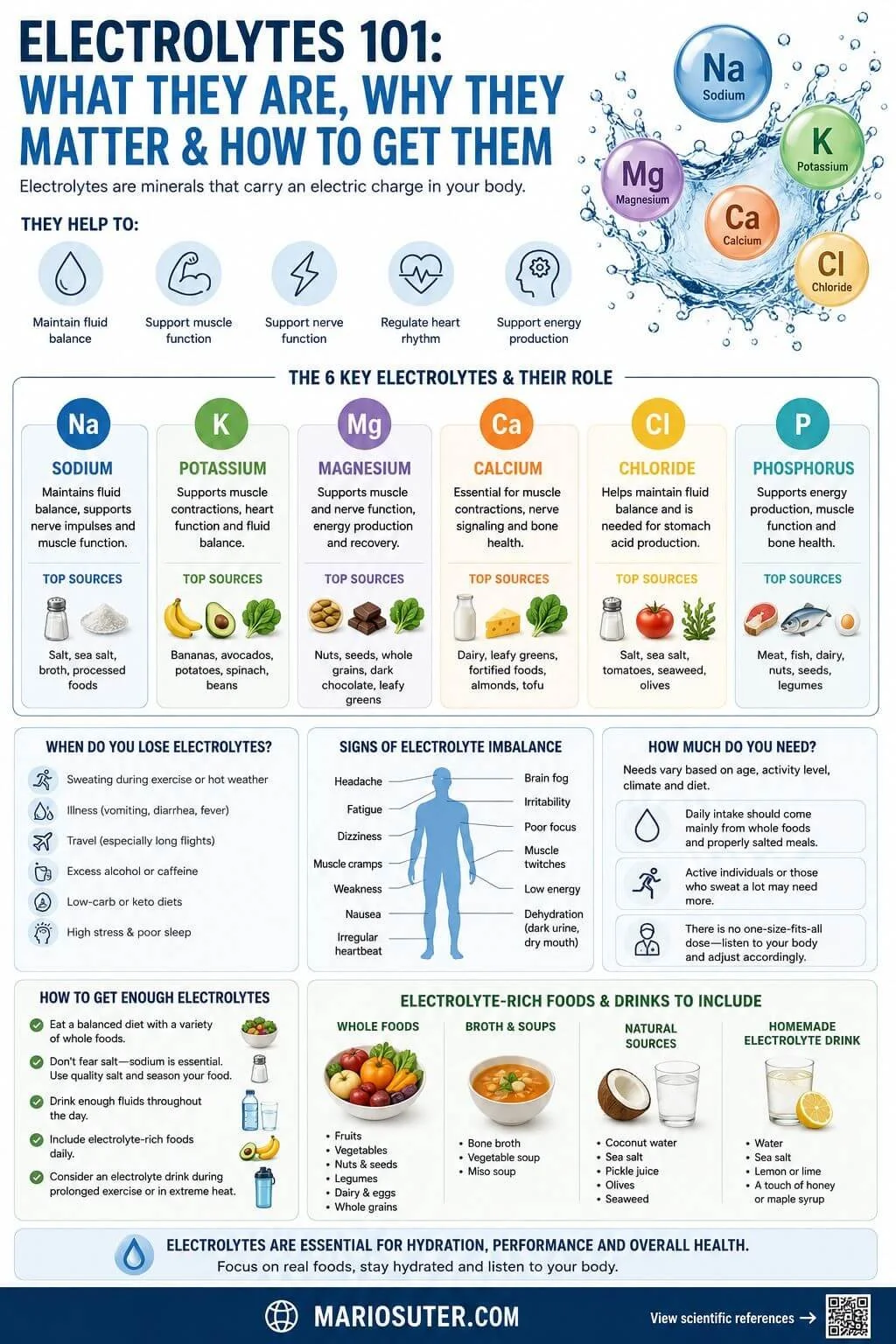
From muscle cramps to brain fog, here is how electrolytes impact your daily energy- and how to replenish them using real food. Save and share the infographic!
What are electrolytes?
Electrolytes are minerals that carry an electrical charge when dissolved in fluid.
“Brawndo’s got electrolytes. It’s what plants crave.”
They help regulate:
✔ fluid balance
✔ nerve signalling
✔ muscle contraction
✔ blood pressure
✔ acid-base balance (including blood pH)
✔ temperature regulation
✔ heart rhythm
The main electrolytes include:
Sodium (Na⁺)
The big one.
Sodium helps regulate:
fluid retention
blood volume
sweat replacement
nerve signalling
muscle contraction
When people talk about “electrolytes,” they’re often mainly talking about sodium.
Potassium (K⁺)
Important for:
muscle contractions
nerve transmission
heart rhythm
balancing sodium
Good food sources:
bananas
potatoes
beans
yoghurt
coconut water
Magnesium (Mg²⁺)
Supports:
muscle relaxation
recovery
sleep
energy production
Calcium (Ca²⁺)
Known for bones, but also essential for:
muscle contraction
nerve signalling
heart function
Chloride (Cl⁻)
Works closely with sodium to maintain fluid balance.
Do you lose electrolytes when you sweat?
Yes.
Sweat contains:
mostly sodium
chloride
smaller amounts of potassium
tiny amounts of magnesium and calcium
Sweat sodium losses vary massively between people.
Some athletes lose very little.
Others are what we call “salty sweaters” and can lose over 1000 mg sodium per litre of sweat.
This is one reason generic hydration advice often fails.
Sweat loss, environment, intensity, genetics, acclimatisation, and nutrition all matter.
Part 1: Do recreational exercisers or busy professionals need electrolytes?
Usually... not necessarily.
If you:
work in an office
train 30 to 60 minutes
do strength training
play social padel
go for a run before work
...water is often enough.
Research suggests fluid needs are often relatively low during recreational exercise under 60 minutes, especially in cooler conditions. Interestingly, one study found that adults who started exercise mildly dehydrated reported a less positive psychological response to their workout than those who arrived well hydrated.
When electrolytes may help
You may benefit if:
✔ training in Barcelona summer heat
✔ multiple padel matches
✔ long hikes or bike rides
✔ heavy sweaters
✔ sauna use
✔ travelling or flying
✔ GI illness, vomiting, diarrhoea
✔ low-carb diets that increase sodium losses
➟ If you play padel regularly, especially in the Spanish summer, hydration can quickly become a performance limiter. I break down practical fueling, hydration, and recovery strategies in my guide to padel nutrition for performance.
Common signs you may be under-hydrated
Possible signs include:
darker morning urine
unusual fatigue
headaches
dizziness
reduced concentration
cramps
poor recovery
brain fog
*These are very general symptoms and not all of these automatically mean “electrolyte deficiency,” but hydration is worth assessing.
Part 2: Electrolytes for serious athletes
This is where things change.
For:
endurance athletes
tournament padel players
triathletes
cyclists
footballers
CrossFit competitors
athletes training twice daily
Electrolytes become much more relevant.
Even a ~2% body mass loss through fluid loss may impair endurance performance, especially in heat.
Sweat losses can quickly exceed fluid intake opportunities.
That’s where planned hydration, not just drinking when thirsty, may matter.
Water vs sports drinks vs electrolyte drinks
This gets interesting.
A recent systematic review found that hypotonic carbohydrate-electrolyte drinks may support hydration better than isotonic drinks or water during prolonged continuous exercise.
That does not mean everyone needs sports drinks.
It means drink composition starts to matter when:
sessions are long
sweat losses are high
intensity is high
carbohydrate availability matters
Do fancy electrolyte powders outperform food?
Sometimes.
But not always.
For many recreationally active people:
A meal containing:
water
fruit
yoghurt
soup
salted food
can do the job.
For elite athletes, convenience, precision, and gut tolerance may make targeted products useful.
Can a banana and water work as well as a sports drink?
Yes... sometimes.
A study in trained cyclists found that banana + water performed just as well as a carbohydrate sports drink during a 75 km time trial. Bananas also provided natural carbohydrates, potassium, vitamin B6, and antioxidants.
The catch?
Bananas are rich in potassium, but sweat losses are usually highest in sodium.
So for everyday exercise, a banana and water may be all you need.
For long, hot, high-sweat sessions... sodium still matters.
⏱️ 1-Min Homemade Electrolyte Sports Drink
For a 600–700 ml bottle:
- 500 ml water
- 2 tbsp honey or maple syrup
-
2 tbsp lemon/lime juice
(or 100 ml orange juice) - 1/4 tsp pink himalayan salt or sea salt
Quick method:
Add a splash of warm water first to dissolve the honey and salt. Top up with cold water, shake, and play.
💡 Why it works
- ~30g fast carbs for energy
- Sodium helps replace sweat losses
- Real-food ingredients
- Easier on the stomach than many sports drinks
- No artificial sweeteners or colours
My practical framework
I usually break it down like this:
Water is often enough if:
✔ session <60 minutes
✔ moderate climate
✔ light to moderate sweat loss
Consider electrolytes if:
✔ session >60–90 minutes
✔ back-to-back sessions
✔ hot and humid conditions
✔ visible salt stains on clothing
✔ frequent cramps or big post-session fatigue
Consider carbohydrates + electrolytes if:
✔ tournament day
✔ long endurance sessions
✔ high-intensity competition
✔ limited access to recovery food
My take as a nutritional therapist
Electrolytes are not magic.
They’re not a lifestyle accessory.
And they’re definitely not a substitute for:
good nutrition
enough sleep
adequate salt intake
recovery
personal responsibility
But in the right context...
They can absolutely improve:
hydration
recovery
training quality
focus
decision-making
repeat performance
And that matters whether you’re in the boardroom... or on centre court.
## Visual Guide: Everything You Need to Know About Electrolytes
FAQ
Do I need electrolytes if I only go to the gym?
Usually not. For most gym sessions under 60 minutes, water is often enough, especially in cooler conditions. Electrolytes may become more useful during longer sessions, heavy sweating, or training in hot environments.
Are electrolytes better than water?
Not always. For everyday hydration, water is often sufficient. Electrolytes may offer an advantage during prolonged exercise, heavy sweating, illness, or when sodium losses are high.
Can a banana and water work as well as a sports drink?
In some situations, yes. Research in trained cyclists found that bananas and water performed just as well as a carbohydrate sports drink during a 75 km cycling trial. Bananas also provide natural carbohydrates, potassium, and plant compounds, although they do not replace sodium losses as effectively during heavy sweating.
Can electrolytes help prevent muscle cramps?
Sometimes, but cramps are complex. Hydration, sodium losses, fatigue, pacing, conditioning, and neuromuscular factors may all play a role. Electrolytes can help in some situations, but they are not a guaranteed fix.
Can you drink too many electrolytes?
Yes. More is not always better. Overusing electrolyte products without significant sweat losses may add unnecessary sodium, sugar, or calories. Your hydration strategy should match your actual needs, environment, and training demands.
View scientific references
Kalman DS, Feldman S, Krieger DR, Bloomer RJ. Comparison of coconut water and a carbohydrate-electrolyte sport drink on measures of hydration and physical performance in exercise-trained men . Journal of the International Society of Sports Nutrition. 2012;9:1.
Kenefick RW, Cheuvront SN. Hydration for recreational sport and physical activity . Nutrition Reviews. 2012;70(Suppl 2):S137–S142.
Millard-Stafford M, Snow TK, Jones ML, Suh H. The beverage hydration index: Influence of electrolytes, carbohydrate and protein . Nutrients. 2021;13(9):2933.
Nieman DC, Gillitt ND, Henson DA, Kennerly KM, Shanely RA, Jin F, et al. Bananas as an energy source during exercise: A metabolomics approach . PLoS One. 2012;7(5):e37479.
Peacock OJ, Stokes K, Thompson D. Initial hydration status, fluid balance, and psychological affect during recreational exercise in adults . Journal of Sports Sciences. 2011;29(9):897–904.
Rebelo-Marques A, Coelho-Ribeiro B, De Sousa Lages A, Andrade R, Afonso J, Pereira R, et al. Trends and missing links in (de)hydration research: A narrative review . Nutrients. 2024;16(11):1709.
Rowlands DS, Kopetschny BH, Badenhorst CE. The hydrating effects of hypertonic, isotonic and hypotonic sports drinks and waters on central hydration during continuous exercise: A systematic meta-analysis and perspective . Sports Medicine. 2022;52:349–375.