Creatine is one of the most researched supplements in sports nutrition.
For years, it was mainly associated with bodybuilding and gym culture. But newer research is expanding the conversation far beyond strength and muscle growth alone.
Today, creatine is being studied not only for:
strength and muscle performance
repeated sprint sports
recovery and fatigue resistance
but also for:
brain energy metabolism
cognitive performance
sleep deprivation resilience
women’s health
ageing and healthy muscle preservation
At the same time, creatine remains one of the most misunderstood supplements online.
Does it damage kidneys?
Does it cause bloating?
Should women take it?
Is it safe daily?
Can it actually help the brain?
Let’s break down what the evidence currently says.
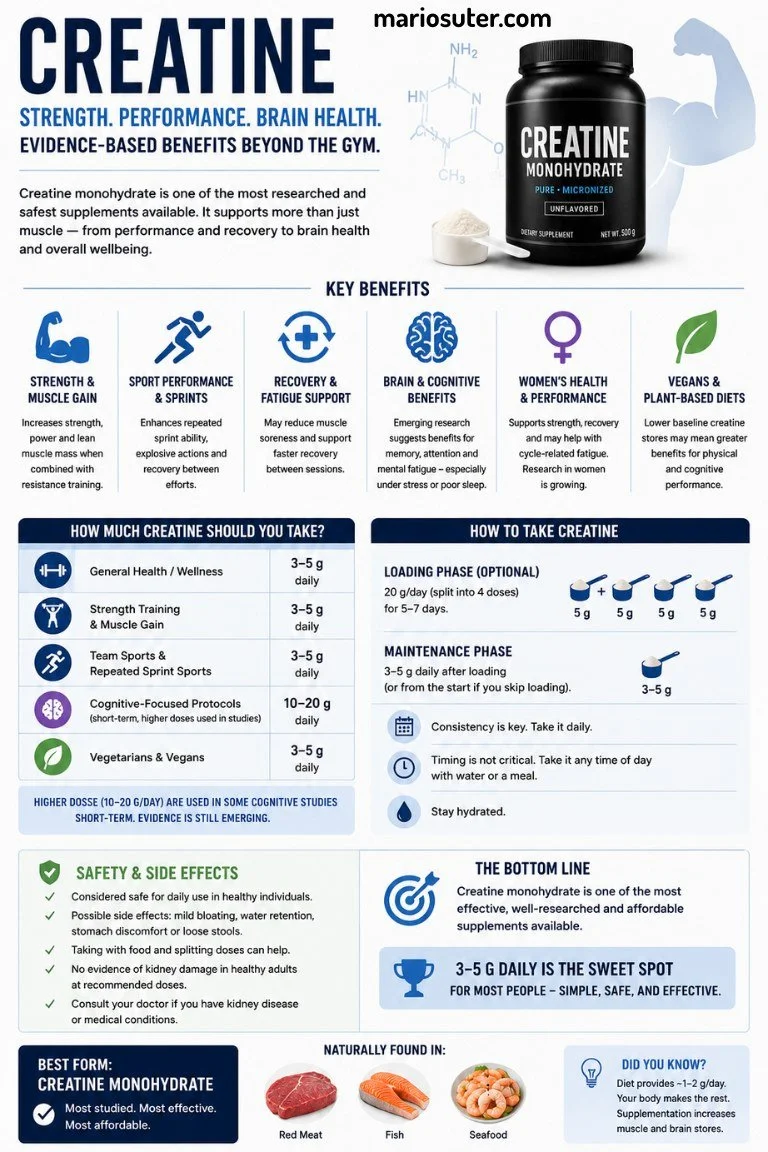
Evidence-based creatine infographic covering strength and muscle gain, sport performance, recovery, brain health, women’s health, dosage guidelines, safety, and side effects. Includes cognitive-focused creatine dosing, daily intake recommendations, and why creatine monohydrate remains the most researched form.
What is creatine?
Creatine is a naturally occurring compound made from amino acids.
Your body stores most creatine inside skeletal muscle, with smaller amounts found in the brain and other tissues. Its main role is helping rapidly regenerate ATP, the body’s immediate energy source during high-intensity activity.
You also obtain creatine naturally from foods such as:
red meat
fish
seafood
However, supplementation can increase muscle creatine stores beyond what diet alone usually provides.
What will creatine do to your body?
The effects depend on:
your training style
diet
baseline creatine stores
muscle mass
activity level
The strongest evidence supports benefits for high-intensity exercise performance.
Creatine for gym performance, strength & muscle growth
This is still where creatine has the strongest evidence.
Research consistently shows creatine can support:
strength output
explosive power
resistance training performance
lean muscle gains
sprint performance
recovery between intense efforts
A recent 2025 meta-analysis found creatine supplementation combined with resistance training significantly increased fat-free mass compared to resistance training alone.
Importantly, both beginners and experienced lifters appear to benefit.
Creatine works especially well for:
strength training
hypertrophy-focused training
CrossFit-style sessions
repeated sprint work
explosive sports
Looking to build muscle and gain healthy weight? Read my guide on What Finally Helped Me Gain Muscle, Appetite, and Size, where I cover calorie surpluses, strength training, appetite, and nutrition strategies that complement creatine supplementation.
Creatine for team sports
Creatine appears particularly useful in sports involving repeated bursts of high-intensity effort.
Examples include:
football/soccer
rugby
basketball
hockey
padel
The main benefits tend to be:
repeated sprint performance
explosive movements
recovery between efforts
maintaining power output during fatigue
A review across multiple sports concluded creatine supplementation can improve high-intensity sprint performance and recovery between repeated efforts.
➟ For a complete guide on what to eat before padel, during long matches, and how to recover properly afterwards, read my padel nutrition and recovery guide.
Creatine and recovery
Newer research is increasingly looking at recovery and fatigue resistance.
A 2026 double-blind study found that only three days of creatine supplementation improved:
strength performance
movement velocity
recovery markers
muscle soreness
in resistance-trained athletes.
This is interesting because creatine is often viewed purely as a “muscle-building supplement”, when in reality its role in cellular energy production may also influence recovery capacity.
➟ Creatine works closely with hydration and cellular fluid balance, which is why understanding electrolytes and performance hydration matters too.
Creatine for endurance athletes
Creatine is not primarily an endurance supplement.
It generally does not improve pure aerobic endurance performance the same way it improves sprint or strength performance.
However, endurance and hybrid athletes may still benefit indirectly through:
improved recovery
better interval quality
stronger sprint finishes
reduced fatigue during repeated high-intensity efforts
This may be particularly useful in sports that combine endurance with repeated explosive actions.
Creatine for brain health and cognitive performance
This is one of the most rapidly growing areas of creatine research.
The brain requires enormous amounts of energy, and creatine may help support ATP regeneration in brain tissue similarly to muscle tissue.
Researchers are currently investigating creatine for:
memory
attention
processing speed
mental fatigue
sleep deprivation
concussion recovery
ageing-related cognitive decline
A 2024 systematic review and meta-analysis found creatine supplementation may improve:
memory
attention time
information processing speed
in some adult populations.
However, the evidence remains mixed.
The European Food Safety Authority (EFSA) reviewed the available evidence in 2024 and concluded that current research is still insufficient to officially approve cognitive health claims for creatine.
So while the research is promising, especially under conditions of stress, fatigue, poor sleep, or ageing, the online claims around “brain optimization” are currently ahead of the evidence.
Does creatine dosage change for cognitive benefits?
Possibly yes.
Standard sports-performance dosing is usually:
3–5 g daily
This works well for:
strength
muscle performance
repeated sprint activity
However, many cognitive studies used significantly higher doses.
Some brain-related studies used:
15–20 g daily
often for short periods such as 5–7 days
Especially in studies involving:
sleep deprivation
mental fatigue
hypoxia
acute cognitive stress
The theory is that the brain may require higher creatine availability than skeletal muscle to meaningfully affect brain phosphocreatine stores.
That said, higher doses also increase the likelihood of:
digestive discomfort
bloating
loose stools
And long-term high-dose cognitive protocols are still under-researched.
From a practical perspective, many people simply use:
3–5 g daily consistently
while some practitioners may increase intake temporarily during:
heavy cognitive workloads
travel
poor sleep
exam periods
intense training blocks
Creatine for women
For years, most creatine research focused heavily on men.
That is now slowly changing.
Emerging research suggests creatine may support women through:
strength and gym performance
recovery
lean mass preservation
menstrual cycle-related fatigue
plant-based diets
cognitive performance
Some evidence suggests women may naturally have lower baseline creatine stores compared to men.
At the same time, female-specific research is still relatively limited and findings remain somewhat mixed.
A 2025 systematic review found some benefits in active females, but not all studies showed significant improvements in performance outcomes.
Is creatine OK to take daily?
For healthy individuals, current evidence suggests yes.
Creatine monohydrate is considered one of the safest and most studied sports supplements available.
Research has investigated both short-term and long-term use across a wide range of populations.
Most people simply take:
3–5 g daily
consistently.
Cycling on and off is generally not considered necessary.
How much creatine should you take?
General health / wellness
3–5 g daily
Strength training & muscle gain
3–5 g daily
Optional loading phase:
20 g/day split into 4 doses
for 5–7 days
followed by maintenance dosing.
Team sports & repeated sprint sports
3–5 g daily
Cognitive-focused protocols
Research studies sometimes use:
10–20 g daily short-term
but evidence is still emerging.
Vegetarians and vegans
Vegetarians and vegans may respond particularly well because baseline creatine stores are often lower due to lower dietary intake from animal foods.
Do you need a loading phase?
No.
Loading simply saturates muscle creatine stores faster.
Without loading:
full saturation may take several weeks
With loading:
saturation may occur within about a week
Both approaches work.
Best form of creatine
Despite aggressive marketing around newer forms, the best-supported version remains:
Creatine monohydrate
It is:
the most researched
the most effective
the most affordable
the form used in most scientific studies
At present, there is little strong evidence that expensive “advanced” creatine products outperform standard monohydrate.
➟ If you are looking for high-quality creatine supplements in Spain and Europe, I also wrote a guide on high-quality supplements in Spain and Europe.
What are the downside of creatine?
Creatine is generally well tolerated, but some people experience side effects.
Possible side effects include:
temporary water retention
mild bloating
digestive discomfort
nausea
loose stools
temporary body weight increase
These effects are often dose-dependent and more common during aggressive loading phases.
Splitting doses and taking creatine with meals can help reduce digestive symptoms.
Does creatine damage kidneys?
This is one of the biggest myths online.
In healthy individuals, current evidence does not support the idea that recommended creatine supplementation damages kidneys.
However, people with:
kidney disease
impaired renal function
significant medical conditions
should speak with their healthcare professional before supplementing.
When should you take creatine?
Timing matters far less than consistency.
The main goal is maintaining saturated creatine stores over time.
Most people simply take creatine:
once daily
with water
alongside a meal or protein shake
Final thoughts
Creatine is no longer just a bodybuilding supplement.
The strongest evidence still supports its use for:
strength
power
muscle performance
repeated sprint sports
But emerging research around:
cognition
sleep deprivation
women’s health
ageing
recovery
is making creatine increasingly interesting beyond athletics alone.
For most healthy adults, creatine monohydrate at 3–5 g daily remains one of the simplest, safest, and most evidence-based supplements available today.
What will creatine do to your body?
Creatine primarily helps improve high-intensity exercise performance by supporting rapid ATP energy production. Research shows it may improve strength, power, repeated sprint performance, recovery, and lean muscle mass gains. Emerging evidence also suggests potential benefits for cognitive performance under stress, fatigue, or sleep deprivation.
Is creatine OK to take daily?
For healthy individuals, current evidence suggests creatine monohydrate is safe for daily use at recommended doses. Most people use 3–5 g daily consistently without needing to cycle on and off.
What are the downside of creatine?
Possible side effects include mild bloating, water retention, digestive discomfort, nausea, loose stools, or temporary body weight increase. These effects are usually dose-dependent and more common during aggressive loading phases.
Does creatine help with brain health and cognition?
Emerging research suggests creatine may support memory, attention, processing speed, and mental fatigue resistance, particularly during stress or sleep deprivation. However, the evidence is still developing and official cognitive health claims are not yet fully established.
How much creatine should I take?
Most people benefit from 3–5 g daily. Some cognitive-focused studies have used higher short-term doses of 10–20 g daily, but these protocols are still being researched and may increase digestive side effects.
Do I need a creatine loading phase?
No. Loading phases simply saturate muscle creatine stores faster. You can either load with around 20 g daily for 5–7 days or take 3–5 g daily consistently and reach similar levels more gradually.
Is creatine bad for your kidneys?
In healthy individuals, current evidence does not support the idea that creatine damages kidneys when used at recommended doses. People with existing kidney disease should speak with their healthcare professional before supplementing.
Can women take creatine?
Yes. Creatine appears safe for healthy women and may support strength, recovery, lean mass preservation, and potentially cognitive performance. Research in women is growing rapidly, although it is still smaller compared to male-focused studies.
What is the best type of creatine?
Creatine monohydrate remains the most researched, effective, and evidence-based form of creatine supplementation.
When should you take creatine?
Timing matters far less than consistency. Most people simply take creatine once daily with water, a meal, or a protein shake.
View Evidence & Research
Kreider RB, Kalman DS, Antonio J, et al. International Society of Sports Nutrition position stand: safety and efficacy of creatine supplementation in exercise, sport, and medicine.
Journal of the International Society of Sports Nutrition. 2017;14:18.
Ashtary-Larky D, Mohammadi S, Hajizadeh L, et al. Creatine supplementation and resistance training: a comparison between novice and experienced lifters.
Journal of the International Society of Sports Nutrition. 2025;22(S1):2586523.
Salem A, Ammar A, Kerkeni M, et al. Short-term creatine supplementation enhances strength, reduces fatigue, and accelerates recovery in resistance-trained athletes.
Journal of the International Society of Sports Nutrition. 2026;22(S1):2617283.
Xu C, Bi S, Zhang W, Luo L. The effects of creatine supplementation on cognitive function in adults: a systematic review and meta-analysis.
Frontiers in Nutrition. 2024;11:1424972.
EFSA Panel on Nutrition, Novel Foods and Food Allergens. Creatine and improvement in cognitive function: evaluation of a health claim.
EFSA Journal. 2024;22:e9100.
Gutiérrez-Hellín J, Del Coso J, Franco-Andrés A, et al. Creatine supplementation beyond athletics: benefits for women, vegans, and clinical populations.
Nutrients. 2025;17(1):95.
Tam R, Mitchell L, Forsyth A. Does creatine supplementation enhance performance in active females? A systematic review.
Nutrients. 2025;17(2):238.