What Should You Actually Drink? A Nutritional Therapist’s Evidence-Based Guide
Most people know water matters.
That part is not the problem.
What I see far more often in practice is confusion around everything after water.
Coffee. Tea. Fruit juice. Sports drinks. Kombucha. Diet drinks. Energy drinks. Flavoured waters.
Some can support health.
Some can quietly work against it.
And some are useful… but only in very specific situations.
If you have not read my hydration guide yet, I recommend starting there first.
Hydration Habits: Why Water Is More Important Than You Think
The goal of this article is simple:
Help you make better drink choices without overcomplicating it.
Water - still and always - comes first
Water remains the foundation.
Not because it is trendy.
Because your body depends on fluid for:
temperature regulation
circulation
digestion
nutrient transport
joint lubrication
cognitive performance
physical recovery
Even mild dehydration can affect energy, concentration, mood, and exercise performance.
In practice, I often tell clients:
If most of your daily drinks are not water, something is probably off.
That does not mean every glass has to be plain.
Make water more interesting, without making it complicated
One of the biggest hydration barriers I see is not knowledge.
It is boredom.
Some people simply drink more when water feels a little more enjoyable.
That does not mean expensive flavoured waters, detox powders, or “wellness” drinks.
Usually, your kitchen is enough.
Make water more interesting:
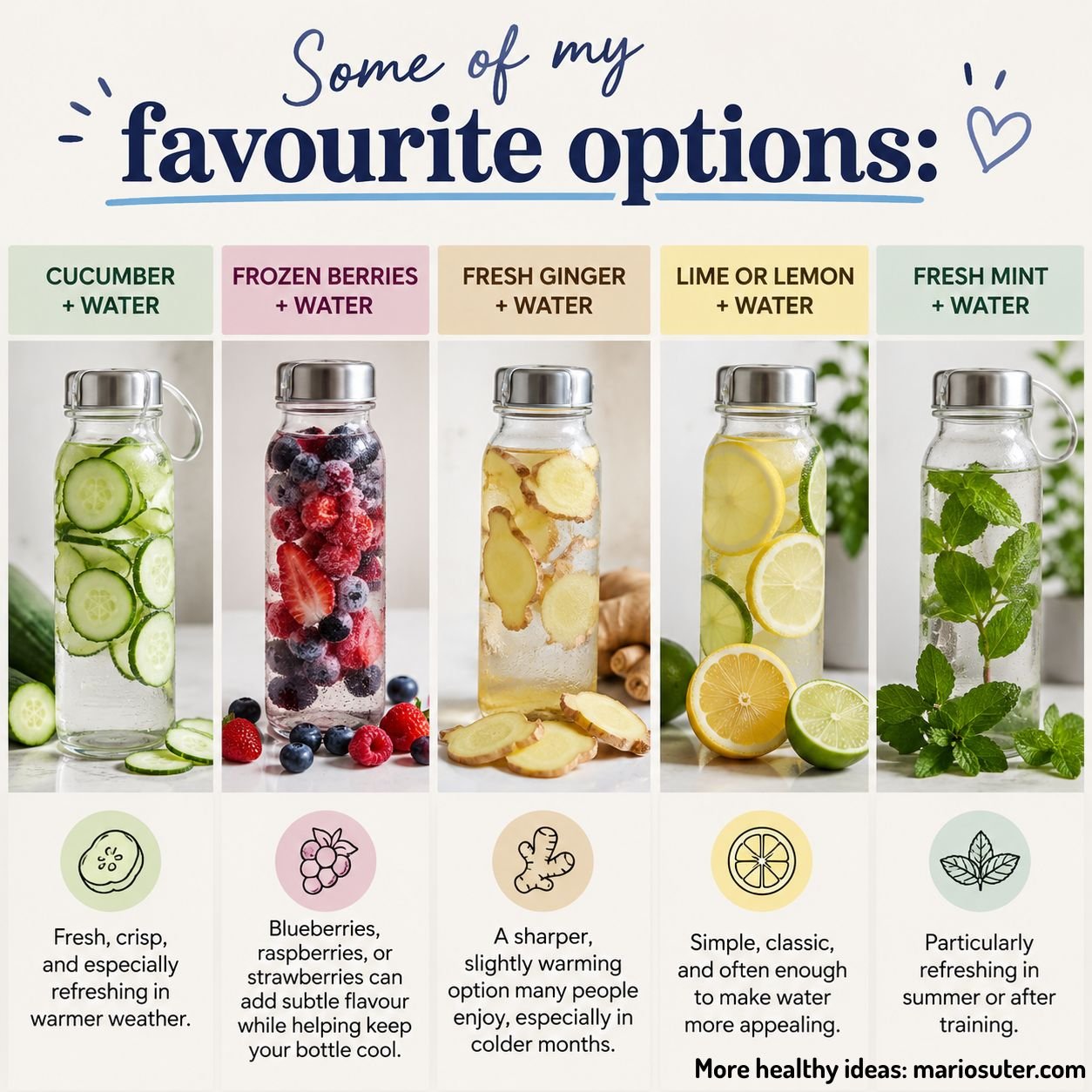
Some of my favourite options:
Cucumber + water
Fresh, crisp, and especially refreshing in warmer weather.
Frozen berries + water
Blueberries, raspberries, or strawberries can add subtle flavour while helping keep your bottle cool.
Fresh ginger + water
A sharper, slightly warming option many people enjoy, especially in colder months.
Lime or lemon + water
Simple, classic, and often enough to make water more appealing.
Fresh mint + water
Particularly refreshing in summer or after training.
Combinations work beautifully too:
cucumber + mint
lemon + ginger
lime + frozen berries
cucumber + lime + mint
None of these magically “detox” your body.
Your liver and kidneys already do that.
But if natural flavour helps you drink more water consistently, that is a win.
Coffee and tea are often better than people think
Coffee and tea are often unfairly demonised.
When consumed sensibly, and with little or no added sugar, both can fit comfortably into a healthy lifestyle.
For many professionals, parents, and athletes, they may support:
focus
alertness
productivity
training performance
That said:
Caffeine is not for everyone. Tolerance varies, and sleep, anxiety, digestion, blood pressure, pregnancy, or certain medications may matter.
The problem is usually not the coffee.
It is what gets added to it.
Large syrups.
Whipped cream.
Extra sugar.
Liquid desserts disguised as coffee.
My advice:
If coffee works for you, enjoy it. Just do not drink dessert five times a day and call it coffee.
Herbal teas deserve more credit
Herbal teas can be a very practical hydration tool.
Especially for people who:
struggle to drink enough water
want to reduce caffeine
snack out of boredom
work in stressful environments
Peppermint, ginger, chamomile, rooibos, lemon balm.
Simple.
Affordable.
And often surprisingly effective for building better habits.
I often use herbal teas with clients who need a healthier “pause ritual” during the workday.
If stress tends to drive your food and drink choices, I explore this in more detail in my guide on nutrition for stress management at work.
Fruit juice is healthier than soda… but still easy to overdo
Store-bought fruit juice can contain vitamins and plant compounds. But it is also very easy to consume a lot of sugar quickly, often with far less fibre than you would get from eating whole fruit.
That is very different from a fresh homemade smoothie, where you keep the fibre and can build in protein, healthy fats, and real whole foods.
My rule is simple:
Eat your fruit more often than you drink it.
A small glass occasionally?
No problem.
A litre every day because it says “100% natural”?
Different story.
Smoothies can be incredibly useful… if built well
I am generally a big fan of fresh homemade smoothies.
They can be especially useful when:
breakfast gets skipped
training demands are higher
appetite is low
recovery needs increase
travel or work makes meals harder
The key is balance.
A good smoothie usually includes:
protein
fibre
healthy fats
real whole foods
Not just fruit and juice.
Simple examples:
Protein: Greek yogurt, kefir, protein powder
Fibre: berries, oats, spinach, chia seeds
Healthy fats: nut butter, flaxseeds, avocado
Sports drinks can be useful… but only when earned
Sports drinks are not “fitness drinks.”
They were designed for specific situations, such as:
prolonged exercise
repeated matches or training sessions
high sweat losses
hot climates
high-intensity efforts where performance and recovery matter
For most people, and for most sessions, water does the job.
For:
a casual gym session
a short run
office life
a light yoga class
You probably do not need them.
It is also worth remembering:
Many commercial sports drinks are still highly processed products, often high in sugar, flavourings, and other additives.
That is why I do not see them as everyday hydration.
For:
tournament days
summer padel matches
double sessions
heavy training blocks
Different story.
This is where electrolytes and carbohydrates may genuinely support hydration and performance.
If you play padel or other sports regularly, I break this down in more detail in my guide on what to eat and drink before padel matches and tournaments.
Energy drinks are where I am usually cautious
Energy drinks are heavily marketed.
Especially to busy professionals, students, and athletes.
The issue is rarely one ingredient.
It is usually the combination of:
caffeine
sugar
stimulants
frequency
poor recovery habits
If you rely on energy drinks every day…
Hydration is probably not the real issue.
More often, we need to look at:
sleep
stress
meal quality
protein intake
recovery
workload
Energy drinks can mask problems.
They rarely solve them.
What about diet drinks and artificial sweeteners?
This topic creates a lot of confusion.
Diet drinks are not the same as sugary drinks.
For some people, they can be a useful short-term transition tool.
Especially if replacing multiple sugary drinks per day.
That said:
I would not build your hydration strategy around artificially sweetened drinks either.
My approach:
Maybe useful as short-term transition. Not your foundation.
Water still wins.
My healthy drinks hierarchy
If you want to simplify things, this is the framework I often use:
Drink freely
Water
Sparkling water
Infused water
Herbal tea
Unsweetened tea
Coffee without added sugar (if caffeine suits you and does not affect sleep, anxiety, digestion, or blood pressure).
Drink strategically
Milk or unsweetened alternatives
Store-bought smoothies or fruit juices
Sports drinks during genuine training demands
Diet drinks as an occasional transition tool, not a hydration foundation
Limit or avoid altoghether
Sugary soft drinks
Energy drinks
Simple.
No extremes.
No perfection.
Just better daily decisions.
Bottom line
Most people do not need more beverage options.
They need fewer decisions.
Build your day around:
water
tea
coffee
real food
Use everything else intentionally.
That alone can improve:
energy
appetite control
recovery
concentration
body composition
long-term health
More than most people expect.
Book a free 15-minute consultation.
FAQ: Healthy Drinks
What is the healthiest drink overall?
For most people, plain water remains the best daily hydration choice. Sparkling water, herbal teas, and unsweetened tea or coffee can also fit well.
Is coffee dehydrating?
Not in moderate amounts. Coffee can contribute to your daily fluid intake, especially if caffeine suits you and intake stays sensible.
Are sports drinks healthy?
Sports drinks can be useful during prolonged or high-intensity exercise, heavy sweating, or repeated matches, but most people do not need them for everyday hydration.
Are energy drinks bad for you?
Energy drinks are usually high in caffeine, sugar, and additives. Occasional use may be fine for some, but they should not replace sleep, recovery, or proper nutrition.
References
View evidence
1. Belval LN, Hosokawa Y, Casa DJ, et al. (2019). Practical Hydration Solutions for Sports. Nutrients, 11(7), 1550. https://doi.org/10.3390/nu11071550