Salmon has a reputation as one of the healthiest foods you can eat. It also has a reputation for being farmed in crowded pens, dyed pink and full of pollutants. So which is it?
The short answer: yes, salmon is healthy for most people, and the benefits usually outweigh the risks. But not all salmon is equal, the omega-3 in farmed salmon isn’t what it used to be, and there are a few situations (pregnancy, sushi, smoked salmon) where it pays to know the details.
Here’s what the evidence actually says, and how to get the most out of it.
Why salmon is so nutritious
A single portion of salmon delivers a lot in one go:
Omega-3 fats (EPA and DHA). These are the long-chain omega-3s your body uses for heart rhythm, brain and eye function, and for resolving inflammation. Plant foods like flaxseed contain a different omega-3 (ALA), which the body converts to EPA and DHA only in small amounts.
High-quality protein, around 20 to 25 g per portion, with all essential amino acids.
Vitamin D, one of the few good food sources of a vitamin many of us are low in, especially in winter.
Vitamin B12 and selenium, important for energy, nerve function, thyroid health and antioxidant defences.
The big picture is reassuring. A major review in JAMA concluded that eating oily fish once or twice a week lowers the risk of dying from heart disease by around a third, and that the benefits clearly outweigh the risks for most adults (Mozaffarian & Rimm, 2006). This is one reason oily fish is a cornerstone of the Mediterranean diet.
Farmed vs wild salmon: what’s the difference?
Almost all the fresh salmon you’ll see in Spanish supermarkets is farmed Atlantic salmon, usually from Norway, Scotland or the Faroe Islands. Wild salmon is mostly Pacific species (sockeye, pink, coho, king), and in Spain you’ll mainly find it frozen or tinned.
Omega-3: farmed salmon has lost about half
This is the part most articles skip. Farmed salmon used to be fed mainly fishmeal and fish oil. To make farming more sustainable, much of that has been replaced with plant oils such as rapeseed. The fish now eat a diet that’s lower in EPA and DHA, and so do we when we eat them.
A study of more than 3,000 Scottish farmed salmon found that EPA and DHA levels roughly halved between 2006 and 2015 (Sprague et al., 2016). In 2006, one 130 g portion covered the recommended weekly intake of 3.5 g. By 2015, you needed two portions to get the same amount.
That said, farmed salmon is fattier than wild salmon, so per portion it still provides as much or more EPA and DHA than many wild salmon, and more than most other foods. It also contains more omega-6 fat, from those plant oils.
Vitamin D: wild is far richer
Wild salmon wins clearly here. Testing found that farmed salmon contained only about 25% of the vitamin D of wild salmon (Lu et al., 2007). The same study found that baking kept almost all the vitamin D, while frying in vegetable oil lost around half.
Colour, fat and sustainability
Colour: Wild salmon gets its pink colour from astaxanthin in krill and shrimp. Farmed salmon is given astaxanthin in its feed, otherwise the flesh would be grey. It’s an antioxidant carotenoid and is used within regulated limits.
Fat: Farmed salmon has more total fat and more calories. Not a problem in itself, but worth knowing if you eat it often.
Sustainability: Both sides have issues (sea lice, escapes and feed sourcing for farms; pressure on some wild stocks). Look for ASC-certified farmed or MSC-certified wild salmon.
Bottom line: Wild salmon is leaner, richer in vitamin D and lower in contaminants, but pricier and harder to find. Good-quality farmed salmon is still a nutritious choice.
What about organic (bio) salmon?
Organic salmon is always farmed. Wild fish can’t be certified organic, because the label covers the animal’s whole life: its feed, living conditions and veterinary care.
Compared with conventional farmed salmon, organic salmon is raised with more space per fish, organic and more sustainably sourced feed, colour from natural sources only, and stricter limits on medicines. That makes it a better choice for animal welfare and the environment. There’s little research showing it’s more nutritious or lower in contaminants, though, so think of it as an ethical upgrade rather than a health one.
In Spain, look for the EU organic leaf logo, often labelled ecológico or bio.
Salmon contaminants: should you worry?
Mercury
Salmon is low in mercury. Mercury builds up in fish closer to the top of the food chain, such as swordfish, shark and bluefin tuna, because they eat other fish and live for many years. Salmon sits lower down, which makes it one of the safer fish choices, including in pregnancy.
Salmon is also rich in selenium, a mineral that binds to mercury and appears to protect the body against its harmful effects (Ralston & Raymond, 2010). Fish that contain more selenium than mercury, which includes salmon, sardines and mackerel, are considered among the safest to eat.
PCBs and dioxins
These are industrial pollutants that persist in the environment and accumulate in animal fat, including fish fat. A well-known 2004 study found higher levels in farmed salmon than in wild salmon, with European farmed salmon among the highest (Hites et al., 2004). That study made headlines for years.
What’s changed since then:
Contaminant levels in Norwegian farmed salmon fell substantially between 1999 and 2011, largely because more plant ingredients replaced fish oil in the feed (Nøstbakken et al., 2015). Ironically, the same change that lowered omega-3 also lowered contaminants.
In 2018, the European Food Safety Authority lowered the tolerable weekly intake for dioxins and dioxin-like PCBs sevenfold, and noted that many Europeans exceed it from their overall diet (EFSA CONTAM Panel, 2018). These pollutants come from many animal foods, not just fish.
My take: For most adults eating salmon once or twice a week, the heart and brain benefits outweigh the contaminant risk. The smart move isn’t avoiding salmon, it’s variety: rotate salmon with smaller oily fish, which sit lower in the food chain.
If you’re interested in how omega-3s fit into the bigger inflammation picture, I’ve written about that in Inflammation: Friend, Not Enemy.
Smoked salmon and sushi: what to know
Smoked salmon
Smoked salmon keeps most of its omega-3 but is salty, often around 3 g of salt per 100 g. Enjoy it, but treat it as an occasional food rather than a daily one, especially if you’re watching your blood pressure.
Pregnancy
Cooked salmon is one of the best foods in pregnancy: low in mercury and rich in DHA for the baby’s brain and eye development. A Cochrane review found that omega-3 intake during pregnancy lowered the risk of preterm birth (Middleton et al., 2018).
But cold-smoked salmon and raw salmon (sushi, poke, tartare) carry a risk of listeria, a bacterium that is rare but can be serious in pregnancy. Spain’s food safety agency, AESAN, advises pregnant women to avoid raw fish. Freezing kills parasites but not bacteria.
If you’re pregnant and not sure your diet covers your omega-3, iron or vitamin D needs, this is exactly the kind of thing I help with, alongside my pregnancy yoga work.
Sushi in Spain: the anisakis freezing rule
Anisakis is a parasite found in many wild fish. In Spain, restaurants are legally required to freeze fish served raw or lightly marinated, and AESAN recommends that at home you freeze fish for raw dishes in a freezer that reaches -20 °C, for at least five days, or buy it already frozen. Farmed salmon is considered very low risk, but the rule is a sensible habit for any homemade sushi, ceviche or boquerones en vinagre.
How often should you eat salmon?
Most health authorities recommend at least two portions of fish a week, one of them oily. Spanish guidelines go further and suggest three to four portions of fish a week.
A practical approach for most adults:
1 to 2 portions of oily fish a week, with salmon as one option among several
Rotate with sardines, mackerel, anchovies, trout and herring
Bake, grill or steam rather than fry, to keep the vitamin D
Pregnant or breastfeeding: cooked salmon is great; skip raw and cold-smoked
Cheaper alternatives (often better)
Small oily fish are the unsung heroes here. Sardines, mackerel and anchovies are rich in omega-3, lower in contaminants because they’re small and short-lived, much cheaper, and often caught locally in Spanish waters. Tinned sardines with their bones also give you a good dose of calcium.
A simple salmon dinner idea
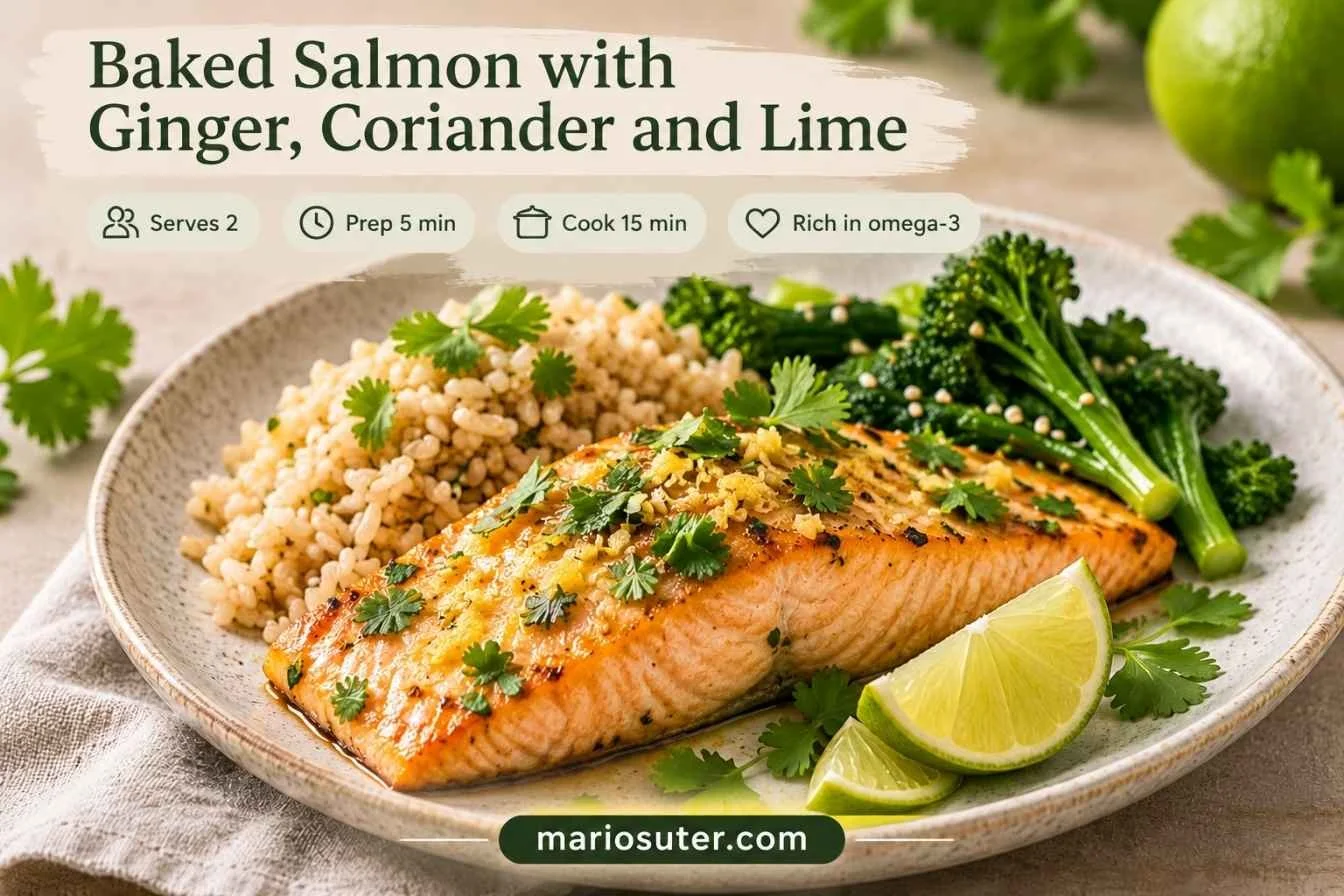
Baked Salmon with Ginger, Coriander and Lime
Ingredients
- 2 wild salmon fillets
- 1 thumb fresh ginger, grated
- 1 garlic clove, grated
- 1 tbsp soy sauce or tamari
- Juice of 1 lime
- 1 tbsp olive oil
- A handful of fresh coriander
- To serve: brown rice and steamed greens or cabbage salad
Method
- Heat the oven to 200 °C.
- Mix the ginger, garlic, soy sauce, lime juice and olive oil.
- Place the salmon in a baking dish and spoon the mixture over the top.
- Bake for 12 to 15 minutes, until the fish flakes easily.
- Scatter with coriander and serve with rice and greens.
Why it works: Baking keeps almost all the vitamin D in the fish, and the greens add fibre and colour. Not a coriander fan? It really does taste like soap to some people, thanks to genetics. Swap in spring onion and basil.
Don’t eat fish? You may need a supplement
If you rarely or never eat oily fish, your omega-3 intake is probably low. This matters more for some people than others: during pregnancy, if you’re managing heart health, inflammation or mood, and for many men over 40 looking after their cardiovascular health.
I always start with food first (more on that in Food First. Then Supplements.), but when food isn’t realistic, a good-quality fish oil or algae oil can fill the gap. Quality varies a lot, though, in dose, freshness and purity.
Not sure where you stand? An Omega-3 Index blood test measures the EPA and DHA in your red blood cells. A level of 8% or above is linked with the lowest cardiovascular risk, and most people in Europe test well below that (Harris & von Schacky, 2004). It’s a simple finger-prick test you can do at home.
How I can help
If you’d like to know whether your diet is giving you enough omega-3, or you want a clear plan for fish, supplements and testing, I can help. In a consultation, we’ll:
Look at what you actually eat and where the gaps are
Decide whether testing (such as the Omega-3 Index or vitamin D) makes sense for you
If you need a supplement, choose the right type and dose, so you’re not wasting money
I work with clients online in English and German, and in person in Barcelona.
Book a free discovery call and let’s work out what your body actually needs.
FAQ
Is salmon healthy to eat every day?
For most people, one to two portions of salmon a week is a better target than daily. Salmon is nutritious, but rotating it with other oily fish such as sardines, mackerel and anchovies gives you the same omega-3 benefits while keeping your exposure to contaminants like PCBs and dioxins lower.
Is farmed salmon bad for you?
No. Farmed salmon is still a good source of protein, omega-3, B12 and selenium. Its omega-3 content has roughly halved since 2006 because of changes in feed, and it contains less vitamin D than wild salmon, but for most adults the benefits of eating it once or twice a week outweigh the risks.
Is organic salmon wild or farmed?
Organic salmon is always farmed. Wild fish cannot be certified organic because the label covers the animal's whole life, including feed and living conditions. Organic salmon is raised with more space, more sustainable feed and stricter limits on medicines, which makes it a better welfare and environmental choice, though there is little evidence that it is more nutritious.
Is wild salmon healthier than farmed salmon?
In several ways, yes. Wild salmon is leaner, contains around four times more vitamin D and tends to be lower in contaminants. Farmed salmon is fattier, so it can provide a similar or higher amount of omega-3 per portion. Both are healthy choices.
Can I eat salmon during pregnancy?
Yes, cooked salmon is an excellent choice in pregnancy because it is low in mercury and rich in DHA. Avoid raw salmon (sushi, poke, tartare) and cold-smoked salmon, which carry a small risk of listeria. Spain's food safety agency, AESAN, advises pregnant women to avoid raw fish.
Do I need to freeze salmon before making sushi at home?
In Spain, AESAN recommends freezing fish that will be eaten raw at -20 °C for at least five days in a home freezer, or buying it already frozen, to kill the anisakis parasite. Farmed salmon is considered very low risk, but freezing is a sensible habit. Freezing does not remove bacteria, so freshness and hygiene still matter.
What can I eat instead of salmon for omega-3?
Sardines, mackerel, anchovies, herring and trout are all rich in omega-3. Smaller oily fish are usually cheaper, often locally caught in Spain, and lower in contaminants. If you don't eat fish, a good-quality fish oil or algae oil supplement can help, ideally guided by an Omega-3 Index test.
View scientific references
Agencia Española de Seguridad Alimentaria y Nutrición (AESAN). Anisakiasis . AESAN. 2023.
EFSA Panel on Contaminants in the Food Chain (CONTAM), Knutsen HK, Alexander J, Barregård L, Bignami M, Brüschweiler B, et al. Risk for animal and human health related to the presence of dioxins and dioxin-like PCBs in feed and food . EFSA Journal. 2018;16(11):e05333.
Harris WS, von Schacky C. The Omega-3 Index: a new risk factor for death from coronary heart disease? . Preventive Medicine. 2004;39(1):212–220.
Hites RA, Foran JA, Carpenter DO, Hamilton MC, Knuth BA, Schwager SJ. Global assessment of organic contaminants in farmed salmon . Science. 2004;303(5655):226–229.
Lu Z, Chen TC, Zhang A, Persons KS, Kohn N, Berkowitz R, et al. An evaluation of the vitamin D3 content in fish: Is the vitamin D content adequate to satisfy the dietary requirement for vitamin D? . Journal of Steroid Biochemistry and Molecular Biology. 2007;103(3–5):642–644.
Middleton P, Gomersall JC, Gould JF, Shepherd E, Olsen SF, Makrides M. Omega-3 fatty acid addition during pregnancy . Cochrane Database of Systematic Reviews. 2018;11(11):CD003402.
Mozaffarian D, Rimm EB. Fish intake, contaminants, and human health: evaluating the risks and the benefits . JAMA. 2006;296(15):1885–1899.
Nøstbakken OJ, Hove HT, Duinker A, Lundebye AK, Berntssen MHG, Hannisdal R, et al. Contaminant levels in Norwegian farmed Atlantic salmon (Salmo salar) in the 13-year period from 1999 to 2011 . Environment International. 2015;74:274–280.
Ralston NVC, Raymond LJ. Dietary selenium's protective effects against methylmercury toxicity . Toxicology. 2010;278(1):112–123.
Sprague M, Dick JR, Tocher DR. Impact of sustainable feeds on omega-3 long-chain fatty acid levels in farmed Atlantic salmon, 2006–2015 . Scientific Reports. 2016;6:21892.