
How to Get Kids Eating More Fruit and Vegetables Without Hiding Them
Practical strategies that actually work, backed by science
One week your child happily eats broccoli.
The next week it’s apparently inedible.
If you’re a parent, you’ve probably been there.
Many parents know the classic trick.
Finely grated carrots in a Bolognese sauce. Courgette blended into pasta sauce. Spinach hidden in a smoothie.
And to be fair, for some dishes that works.
But long term, hiding vegetables doesn’t really help with picky eating, nor does it teach children to recognise, accept, or eventually enjoy them.
As a dad, nutritional therapist, and someone who supports families both in person in Barcelona and online, I’ve found something much simpler often works better.
Not disguising vegetables.
Just making them normal.
Why fruit and vegetables matter in childhood
Fruit and vegetables do far more than provide vitamins.
They help support:
healthy growth and immune function
digestion and gut health
stable energy throughout the day
concentration and learning at school
long-term eating habits that often carry into adult life
Emerging research also suggests that diets rich in fruit and vegetables may support children’s cognitive and mental wellbeing, although more intervention studies are still needed.
Start with what’s easy
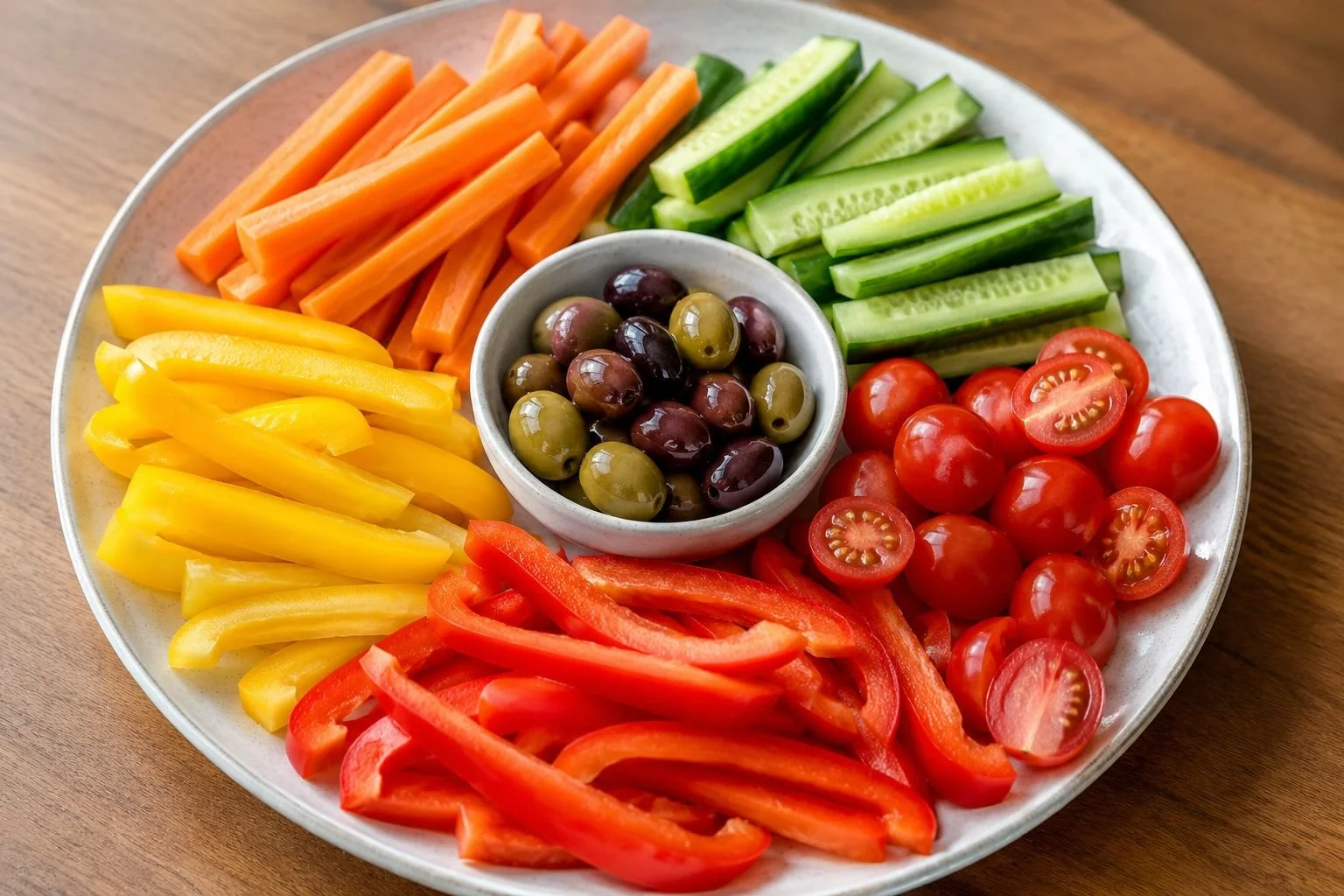
At home, one strategy works very well with my own kids.
Before dinner, or alongside the meal, I put a large plate in the middle of the table with cucumber, carrot sticks, bell peppers, cherry tomatoes, and olives.
This isn’t accidental. I do it deliberately, because when children arrive at the table hungry, curiosity and appetite are often working in your favour. Instead of leading with pasta, bread, or the main dish, the vegetables are already there, visible, easy to grab, and part of the experience from the very first few minutes.
More often than not, they start eating them immediately, and then keep coming back to them throughout the meal. No pressure. No negotiations. No “three more bites.” Just easy access, routine, and repetition.
Simple.
And science suggests there may be something to this.
A study from Japan found that preschool children who regularly ate vegetables first at a meal had significantly higher overall vegetable intake compared with children who didn’t. Children who ate vegetables first every time consumed 93% more vegetables than those who rarely or never did.
That doesn’t mean every family needs a strict rule.
But it does suggest that what children eat first may influence what they eat most.
Use hunger and habit to your advantage
Another simple strategy we use at home has nothing to do with dinner.
Movie night.
Like many families, popcorn or crisps may show up... but not first.
First comes a plate of fresh fruit and vegetables, changing slightly with the seasons. In winter that might be mandarins, apple slices, cucumber, or carrot sticks. In summer, berries, cherries, melon, peppers, or cherry tomatoes often make an appearance. The rest of the year, whatever is fresh, simple, and easy to grab.
By the time the popcorn appears, a surprising amount of the healthier food has usually already disappeared.
Again, this isn’t about restriction.
It’s about using appetite, visibility, and timing to your advantage. When healthier foods show up first, children often eat more of them without it feeling like a nutrition lecture.
Make vegetables visible, not invisible
Children are heavily influenced by what they see regularly at home.
Research shows that food availability and repeated exposure strongly influence children’s preferences, and foods that are regularly available tend to get eaten more often.
That’s one reason my kids also take fresh vegetables to school most days.
Usually:
cucumber
carrot
peppers
olives
apples
bananas
berries when in season
Nothing fancy or Instagram-worthy.
Just consistent exposure.
And consistency matters.
Research suggests that many food preferences are learned, not fixed, and repeated exposure can gradually reduce resistance to new foods over time.
In other words:
A child saying “I don’t like it” today doesn’t mean they won’t like it six months from now.
Sometimes simplicity beats “healthy recipes”
Parents often feel they need to make vegetables exciting.
Hidden muffins. Vegetable pancakes. Rainbow pasta. Instagram lunch boxes.
Sometimes that’s fun.
But sometimes simplicity wins.
At home, I’ve found children often respond best when vegetables are prepared well... and then left alone.
My kids love broccoli, for example. Not covered in cheese. Not blended into soup. Just lightly steamed so it keeps a little crunch, finished with a drizzle of extra virgin olive oil and a pinch of salt just before serving.
Carrots might be raw and cold from the fridge.
Cucumber simply sliced.
Cherry tomatoes whole.
Bell peppers cut into strips.
And in winter, something like roasted pumpkin, sweet potato, or parsnips often goes down surprisingly well.
Research suggests that familiarity and repeated exposure are among the strongest drivers of vegetable acceptance in childhood. In other words, children do not always need vegetables to be disguised, sweetened, or turned into a “recipe.” Often, they simply need the chance to see them, taste them, and experience them again and again.
Sometimes the goal is not to make vegetables more complicated.
Sometimes it’s simply to make them... normal.
My “secret” family snack

My “secret” family snack
One simple snack my kids have grown up with might surprise some parents.
Artichokes.
Simply boiled in water with a little fresh lemon until tender, then served warm or at room temperature.
Then we eat them leaf by leaf, a fun finger food.
It’s hands-on, a little messy, and children often enjoy the process as much as the food itself.
A good reminder that helping children eat more fruit and vegetables is not always about recipes, hiding ingredients, or making food look “kid-friendly.”
Sometimes it’s simply about making healthy food part of normal family life... and occasionally making it a little fun.
www.mariosuter.com
Different ages, different challenges
Toddlers (1 to 3 years)
This is often when food neophobia kicks in, meaning children naturally become more cautious of unfamiliar foods. A vegetable they loved at 12 months may suddenly be refused at age two.
This is normal.
Keep offering fruit and vegetables early in the meal, when appetite is highest. What children are exposed to regularly in these early years often becomes what feels familiar, safe, and worth eating later on. Repeated exposure early in life can help build lasting acceptance of vegetables.
Preschool children (3 to 5 years)
This is a great age to experiment with “vegetables first.”
Small portions - or big. Easy wins.
School-age children
Routine becomes powerful.
Lunchboxes, family meals, after-school snacks, and what’s visible at home all start shaping long-term habits.
And that matters, because eating habits formed in childhood often track into adulthood.
What usually backfires
In my experience, these tend to create more resistance:
“Just one more bite.”
Negotiating with dessert.
Making vegetables the “healthy chore.”
Offering a second meal if they refuse.
Children often do better when vegetables feel normal... not special, forced, or hidden.
When it may be worth seeking support
If your child has extremely limited food choices, persistent digestive symptoms, poor growth, sensory challenges, or mealtimes consistently feel stressful, it may be worth speaking to your GP, paediatrician, or a qualified nutrition professional.
A final thought for parents
If your child doesn’t love vegetables right now, don’t panic.
This is rarely about perfection.
It’s about exposure, routine, and modelling.
Keep vegetables visible.
Keep them simple.
Keep putting them on the table.
And perhaps most importantly... keep eating them yourself.
➟ Looking to lead by example? My guide Simple Ways to Add More Vegetables to Your Diet shares practical ways adults can make vegetables a more natural part of everyday meals, snacks, and routines.
Children may not always listen to what we say, but they watch closely what we do.
Over time, those small daily exposures, for them and for us, often matter far more than the occasional “perfect” healthy meal.
If you’d like support with picky eating, family nutrition, gut health, or building healthier routines at home, I work with families in Barcelona and online.
FAQ
My child says they don’t like vegetables. Should I stop offering them?
No. Children’s food preferences are learned and can change over time. Repeated exposure, without pressure, is one of the most effective ways to build acceptance of fruit and vegetables.
Should children eat vegetables before the rest of the meal?
It can be a very useful strategy. Research in preschool children suggests that eating vegetables first may increase overall vegetable intake, especially when children arrive at the table hungry.
Is hiding vegetables in sauces or smoothies a good idea?
It can help occasionally, but on its own it does not teach children to recognise, accept, or genuinely enjoy vegetables. Long term, visibility, routine, and repeated exposure tend to work better.
How many times might a child need to try a vegetable before liking it?
Every child is different, but research suggests it may take many repeated exposures before a previously disliked food becomes familiar and accepted. Patience and consistency matter.
View references
Folkvord F, Naderer B, Coates A, Boyland E. Promoting fruit and vegetable consumption for childhood obesity prevention. Nutrients. 2022;14(1):157.
Gillies NA, Lovell AL, Waldie KE, Wall CR. The effect of fruits and vegetables on children’s mental and cognitive health: A systematic review of intervention studies and perspective for future research. Nutrition. 2025;130:112615.
Ragelienė T. Do children favor snacks and dislike vegetables? Exploring children’s food preferences using drawing as a projective technique. Appetite. 2021;165:105276.
Wadhera D, Capaldi Phillips ED, Wilkie LM. Teaching children to like and eat vegetables. Appetite. 2015;93:75–84.
Yang J, Tani Y, Tobias DK, Ochi M, Fujiwara T. Eating vegetables first at start of meal and food intake among preschool children in Japan. Nutrients. 2020;12(6):1762.

Acid Reflux, GERD, and Heartburn: Foods to Avoid + Diet Tips
Caffeine for Sports Performance: Benefits, Timing, Dosage, and What Science Says
Ask Mario
Whether you have a quick question or want to explore working together, feel free to reach out.
Chat on WhatsApp Email me Nowhello@mariosuter.com